
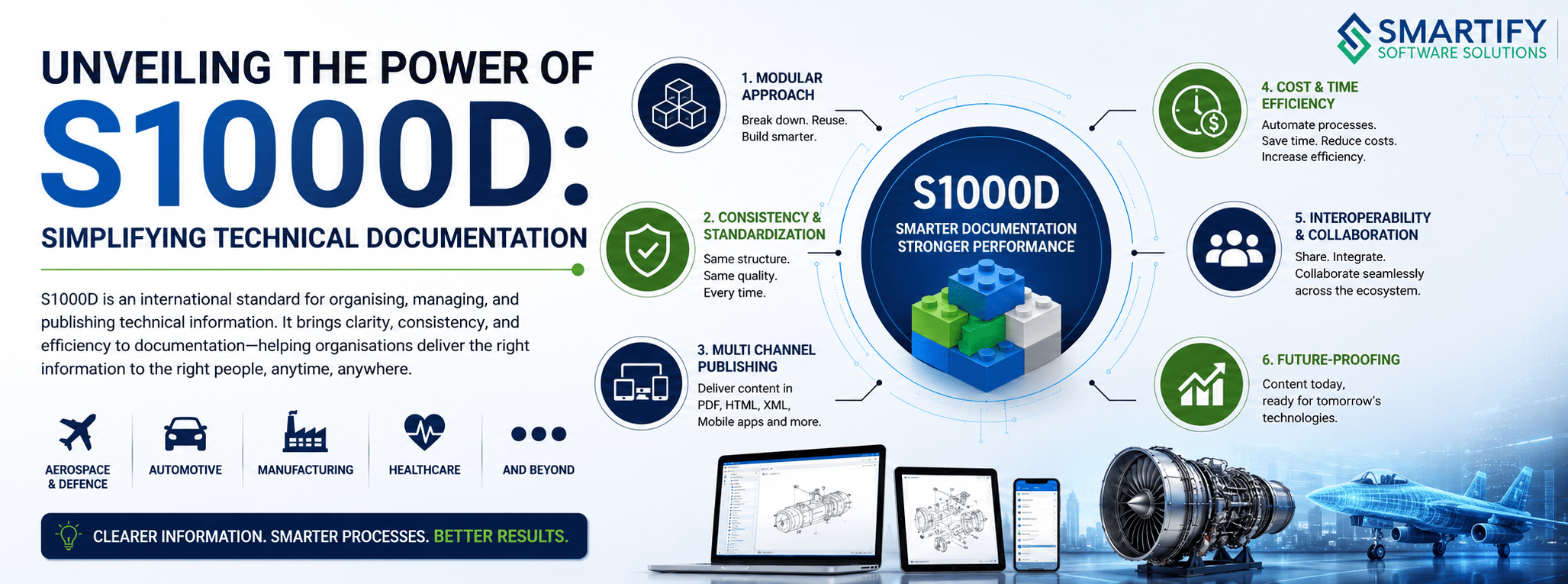
In the realm of technical documentation, clarity and precision are paramount. Whether it’s assembling a complex machine or troubleshooting a sophisticated system, having accurate and accessible documentation is crucial. This is where S1000D steps in as a game-changer, revolutionising the way technical information is managed, shared, and utilised. In this blog post, we’ll delve into the benefits of S1000D in straightforward terms, making it easy to grasp its significance in any industry.
What is S1000D?
S1000D, short for “Specification for Technical Publications Using a Common Source Database,” is an international standard for organising, managing, and publishing technical information. Developed initially for the aerospace and defence industries, S1000D has now expanded its reach into various sectors, including automotive, manufacturing, and healthcare.
Key Benefits of S1000D:
1. Modular Approach: One of the fundamental principles of S1000D is modularity. It breaks down complex technical documents into smaller, reusable modules known as data modules. These modules can be combined and repurposed, significantly reducing redundancy and streamlining the documentation process. Imagine building with LEGO blocks – you can assemble and disassemble them as needed to create different structures without starting from scratch each time.
2. Consistency and Standardization: By adhering to the S1000D standard, organisations ensure consistency across their technical documentation. This standardisation not only enhances the quality of information but also simplifies training and troubleshooting processes. Every piece of information follows the same structure and format, making it easier for users to navigate and understand, regardless of their familiarity with the system.
3.Multi channel Publishing: In today’s digital age, information needs to be accessible across various platforms and devices. S1000D facilitates multi channel publishing, allowing content to be delivered in different formats such as PDFs, HTML, XML, and even mobile applications. Whether it’s a printed manual, an interactive website, or a mobile app, S1000D ensures that users can access the information they need, whenever and wherever they need it.
4.Cost and Time Efficiency: Traditional documentation methods often involve manual processes that are time-consuming and prone to errors. With S1000D, organisations can automate many aspects of the documentation lifecycle, from content creation to publishing. This automation not only saves time but also reduces costs associated with manual labour, rework, and translation. Additionally, the modular approach of S1000D enables content reuse, further optimising efficiency and minimising duplication of efforts.
5. Interoperability and Collaboration: In today’s interconnected world, collaboration is key to success. S1000D promotes interoperability by facilitating the exchange of information between different systems and organisations. Whether it’s sharing technical data with suppliers or integrating documentation with other software tools, S1000D ensures seamless communication and collaboration across the entire supply chain.
6. Future-Proofing: Technology is constantly evolving, and so is the way we consume information. S1000D provides a future-proof solution by separating content from presentation, making it easier to adapt to emerging technologies and changing user preferences. Whether it’s virtual reality (VR) instructions or augmented reality (AR) overlays, S1000D enables organisations to embrace new technologies without overhauling their entire documentation infrastructure.
Conclusion:
In conclusion, S1000D offers a plethora of benefits that revolutionise the way technical information is managed and delivered. From its modular approach to its support for multichannel publishing, S1000D empowers organisations to create clear, consistent, and accessible documentation that enhances user experience and drives operational efficiency. By adopting S1000D, organisations can streamline their documentation processes, reduce costs, improve collaboration, and future-proof their technical information for years to come. So, whether you’re in aerospace, manufacturing, healthcare, or any other industry, embracing S1000D could be the key to unlocking the full potential of your technical documentation.
